Showing posts with label bobbins. Show all posts

Friday, 4 September 2015

Linen Journey 2015 Part 2

As promised some more about my recent visit to the home of Irish Linen.

Thankfully in addition to the artefacts being preserved in museums, there are one or two individual collectors who are doing a great job of saving important linen-related materials and machinery, which might otherwise be discarded or destroyed.

One such collector is a gentleman near Gilford in Co. Down, who has amassed a huge collection. I was fortunate to have the opportunity to visit him and be shown some fascinating memorabilia, machinery and documents. At last I stood in front of the type of machine that would have been used by my great aunt, when she worked as a linen yarn winder in 1901 in Belfast.


Her job involved transferring the linen yarn from the large spools to the smaller pirns or bobbins, which were then inserted into the shuttles and passed to the weavers. She would have worked from 6am to 6pm Monday to Friday and 6am to 12.30 on a Saturday! Long hard hours, for sure.

I have talked about point charts before; but I had never seen ones of the size in this collection! 


Below the chart you can see the salesmen's cards showing the style of the tablecloth designs, each one with its design name and pattern number printed to the top.


And then there were pattern books full of beautiful damask cloths and napkins. Each design was stamped with the pattern number and the size. I thought perhaps these too were salesmen's samples, but apparently it was more likely that they were archive records. The quality of the weaving was just stunning and there were 100s of designs!

So there I was in a huge barn in the middle of a field in the heart of Co. Down (an unlikely place for me, as anyone who knows me will tell you!) and I couldn't believe what a great time I had. So many new facts learned and so many stories recounted. I think I need to go back for another visit sometime soon!


Friday, 22 May 2015

What the postman brought.......finally!

Yesterday had to be the most frustrating day in weeks. Having been told a parcel I was expecting on Monday had indeed been delivered, I had to start playing my version of Pass the Parcel! Only in this case to find out where on earth said parcel had been passed to! No "we called when you were out" card through my door, no help from the courier company and the sender was getting no better information.

Hallelujah, after about 4 hours of annoyance, knocking on neighbours' doors and generally pestering anyone I thought might be able to help me locate the box, my next door neighbour returned from work and had had the parcel all along!

Now to the contents.......

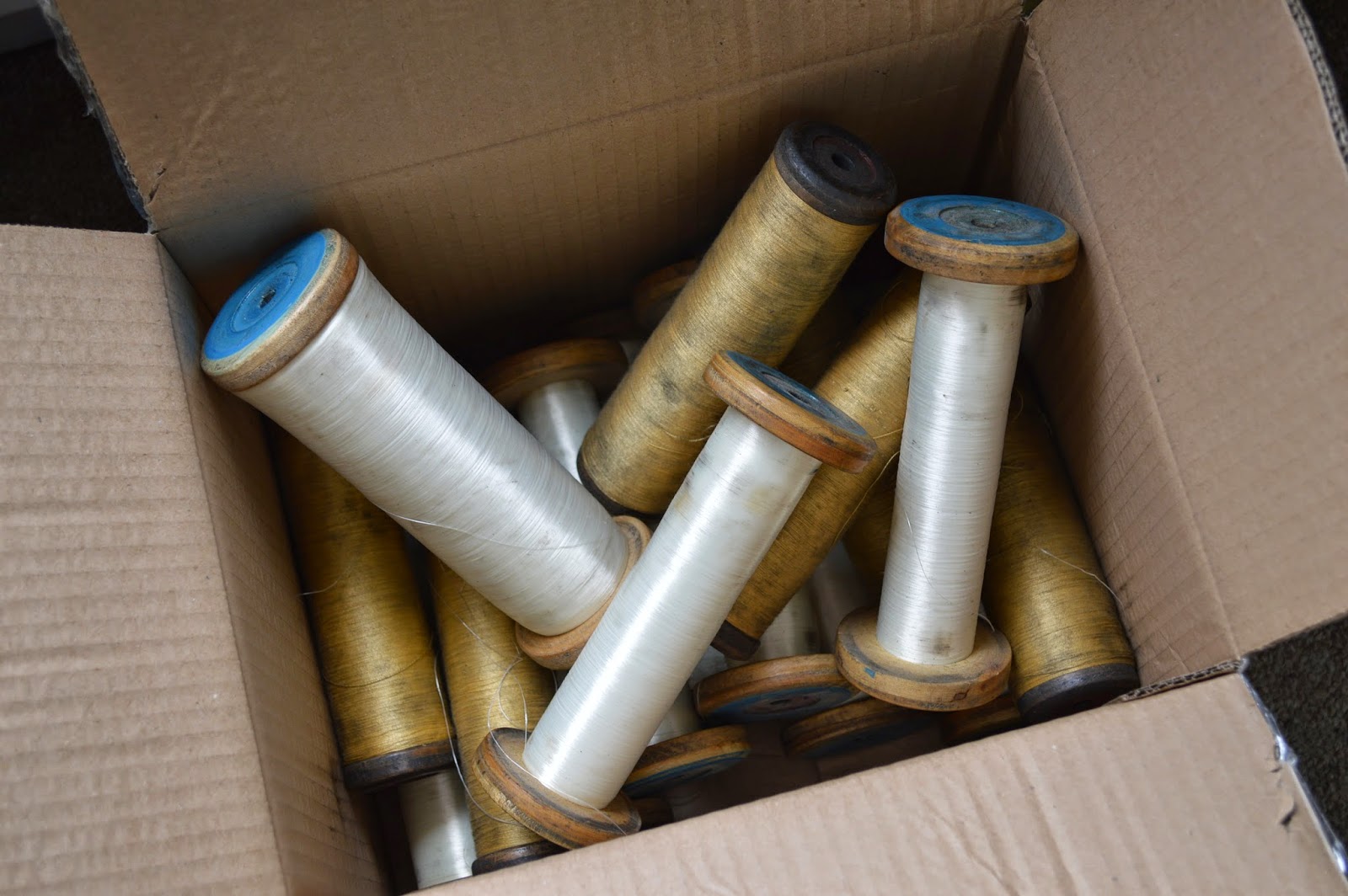
I've had lots more requests for the big cream lace bobbins and was able to acquire the last remaining lot so they will be on their way to new homes soon. The gold coloured ones will have their outer layers of thread removed and soon be on the website refreshed and clean (almost)!


But the box didn't just contain the bobbins, there were 5 wonderful documents also included. Before a jacquard loom can produce a design, whether on cloth or as lace, a series of punched cards has to be made. To do this the original drawing has to be transferred to graph paper. This is known as a point chart with each point or square on the paper corresponding to the raising or lowering of a weft or warp thread.

The guys clearing out the contents of the Scottish lace mill came across a box of these point charts and I just couldn't resist!


Hard to determine the date of these, but they are probably from the 1930s or thereabouts. One in particular caught my eye - with an elephant depicted in the design.


Most likely this would have been a pattern for a lace intended for curtain panels, the handwritten notes tell us this design is called Klambo Lace. Klambo is a village in Malaysia, obviously the inspiration for this unusual pattern. I'd love to have seen the actual woven piece.

All shapes and sizes of charts as some would have been for narrow lace borders, others for more intricate piece goods.


This is some of the lace edging produced in the factory, probably in the 50 or 60s, so it gives an idea of how the chart drawings were interpreted to be woven into finished products.


Instead of just adding these to my bookshelves as interesting documents, I am planning to have some of them framed. I think the elephant one in particular will look fabulous on the wall.

I am so so glad I finally found my parcel........!