Showing posts with label Scottish lace. Show all posts

Friday, 22 May 2015

What the postman brought.......finally!

Yesterday had to be the most frustrating day in weeks. Having been told a parcel I was expecting on Monday had indeed been delivered, I had to start playing my version of Pass the Parcel! Only in this case to find out where on earth said parcel had been passed to! No "we called when you were out" card through my door, no help from the courier company and the sender was getting no better information.

Hallelujah, after about 4 hours of annoyance, knocking on neighbours' doors and generally pestering anyone I thought might be able to help me locate the box, my next door neighbour returned from work and had had the parcel all along!

Now to the contents.......

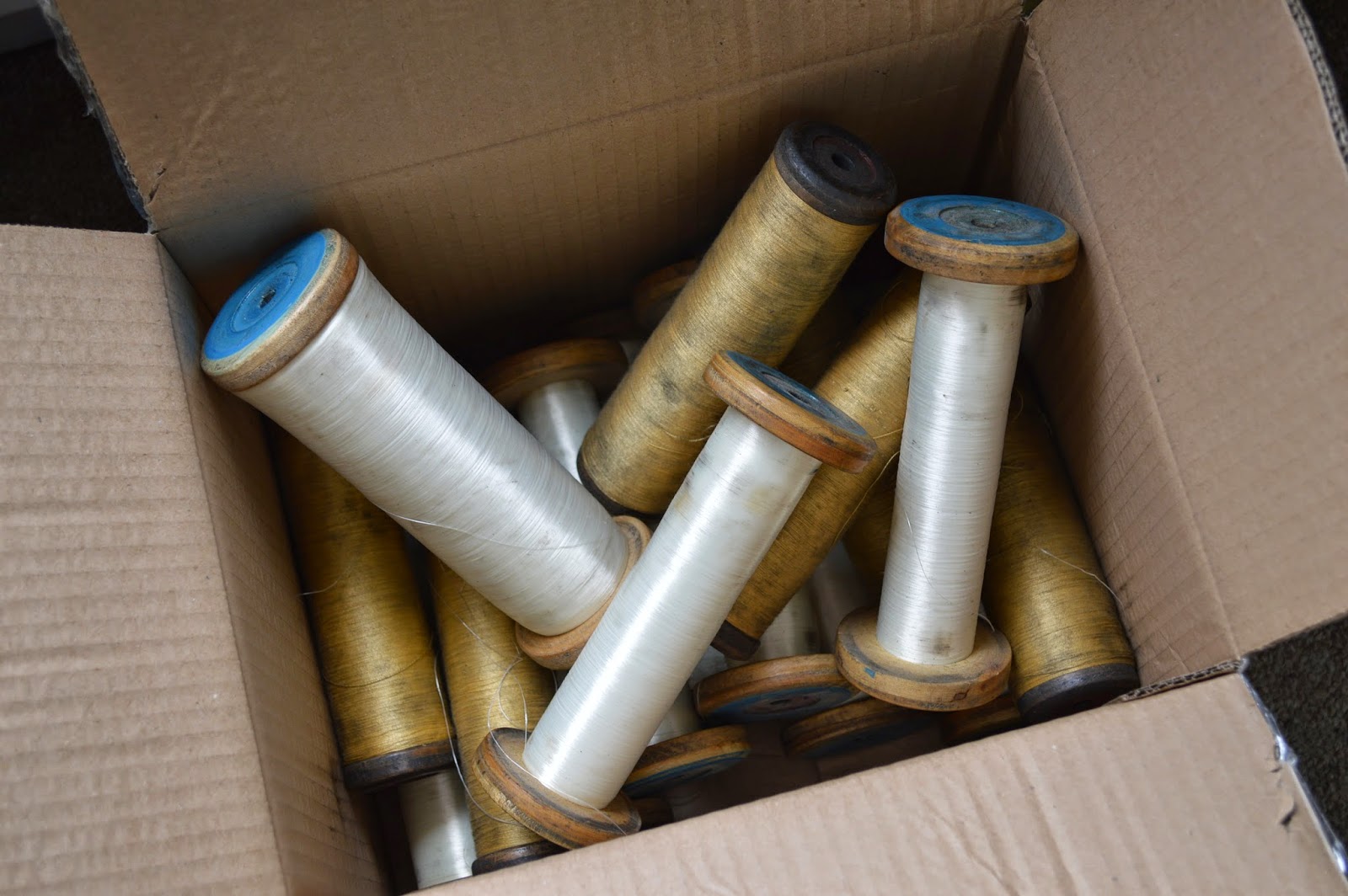
I've had lots more requests for the big cream lace bobbins and was able to acquire the last remaining lot so they will be on their way to new homes soon. The gold coloured ones will have their outer layers of thread removed and soon be on the website refreshed and clean (almost)!

But the box didn't just contain the bobbins, there were 5 wonderful documents also included. Before a jacquard loom can produce a design, whether on cloth or as lace, a series of punched cards has to be made. To do this the original drawing has to be transferred to graph paper. This is known as a point chart with each point or square on the paper corresponding to the raising or lowering of a weft or warp thread.

The guys clearing out the contents of the Scottish lace mill came across a box of these point charts and I just couldn't resist!


Hard to determine the date of these, but they are probably from the 1930s or thereabouts. One in particular caught my eye - with an elephant depicted in the design.


Most likely this would have been a pattern for a lace intended for curtain panels, the handwritten notes tell us this design is called Klambo Lace. Klambo is a village in Malaysia, obviously the inspiration for this unusual pattern. I'd love to have seen the actual woven piece.

All shapes and sizes of charts as some would have been for narrow lace borders, others for more intricate piece goods.


This is some of the lace edging produced in the factory, probably in the 50 or 60s, so it gives an idea of how the chart drawings were interpreted to be woven into finished products.


Instead of just adding these to my bookshelves as interesting documents, I am planning to have some of them framed. I think the elephant one in particular will look fabulous on the wall.

I am so so glad I finally found my parcel........!


Tuesday, 26 August 2014

Collector's items from a Scottish Lace Mill

I recently stumbled on a collection of articles found in the buildings of a former lace mill in Scotland. and last week a rather heavy and dusty parcel arrived containing around 50 assorted bobbins and spools.  Some were just the bare bobbins with the vestiges of brightly coloured paint, whilst others still had much of the yarn in place, but the outer surfaces were dusty and dirty from years of storage in a derelict shell of a building.


As I began to unwind the outer layers, the jewel colours were gradually revealed - fabulous shades of gold and tangerine, ivory and emerald, ebony and ruby red as well as tan, mink and cobalt blue. The bobbins,as you would expect, are showing signs of wear, but they will have been in use for over 100 years for the most part. They are really wonderful pieces of Scottish textile history.


Once the outer layers were discarded the yarns beneath are just as vivid as they day they were wound onto the bobbins. There is still plenty of vintage thread which could be used for all sorts of different projects. I think I would prefer to keep them intact and used them as interesting decorative pieces. 


They would also make great additions to the collection of an antique haberdashery lover. These really are gems reflecting the rich textile history of the area.


When Hugenot refugees arrived in Ayrshire at the end of the 16th century they introduced the skill of textile weaving and over the years this steadily progressed from muslin to lace and in the late 1800s the manufacture of machine lace was the main employment in the town of Newmilns. Johnston, Shields and Co operated in Brown Street from 1880 until 2010, when the mill finally closed its doors.

At least it has been possible to rescue just a small part of the contents of the place. The bobbins will be on the website soon, so not too long to wait to be able to own just a little piece of the industrial heritage of Scotland. Granny Black would have loved to help unpack the box!