Thursday, 2 October 2014

Recycling and repurposing - new ideas?! Hardly.......

I find it very amusing that we think today that recycling is a great new concept, repurposing is another buzz word that we often hear.

Sorry to disappoint anyone, but our grandmothers and great grandmothers had the concept down to a fine art, long before the idea was resurrected in the 1990s and I am reminded of it each time I find a new batch of vintage linens and accessories.


This group of doilies is a perfect example. You can see that the linen centre to each doilie is actually a piece rescued from a damask cloth or napkin that has most likely been damaged. Rather than discard the linen, the frugally minded lady of the house has cut out the undamaged pieces and crocheted or knitted a deep edging so that these precious pieces could still serve a useful purpose and look delightful at the same time!

Going through boxes and cases from an estate sale recently I came on the usual box of pieces of lace. I think just about every house had one of these boxes, usually it had contained silk stockings but was used to hoard the precious pieces of lace which were being saved to rework into different garments and hankies. Often the pieces I find are actually a loop of lace, most likely rescued from a petticoat, saved so that it could be used for something else. Here is one such piece, a pretty loop of ivory filet lace with a  scalloped edge.


 Searching further through the same box of treasures I found a bodice in the most gorgeous peach coloured crepe de chine and along the top was an edging of exactly this design of lace! All hand sewn with narrow ribbon threaded through it to gather it to shape. Even the waistline was finished with a running stitch of the finest elastic thread. This must have made a lovely set of lingerie, shame that the petticoat didn't survive.


So this particular loop of lace was never recycled by its original owner, but I hope that now it will find a new home and become part of another project.

P.S.

At the very bottom of the box was a small blue card, "ERL" Brand Lace is the title. ERL standing for Equals Real Lace! The advertising slogan at the bottom tells us that "ERL equals real lace but Costs Far Less"! The card also tells the buyer that "If you are well satisfied with "ERL" Brand Lace, kindly recommend it to you friends. In doing so you will be helping to support an ALL-BRITISH INDUSTRY." 

There is even a returns policy on the reverse worded in a most charming fashion:

"Any lady, having JUST CAUSE to complain, who sends the whole 6 yard length with this card to the manufacturers A. Herbert Woolley & Co., Nottingham, will receive a perfect length in return, without charge, and post free"

Weren't these guys well ahead of their time with their marketing strategies and customer satisfaction goals!


Friday, 5 September 2014

Gorgeous european linens from the 1930s


Whilst my main collecting interest has always been Irish Linen, I sometimes just cannot resist indulging in linens from elsewhere.

A month or so ago I was fortunate enough to acquire 2 huge bags full of bedlinen, which had been the trousseau of a Czechoslovakian lady. Just prior to the outbreak of  war in 1939 she was studying in Switzerland and her parents, who were Jewish and could see what the future held, told her not to come home but to go to friends in England and they arranged to send on her belongings. Included in the parcels were these beautiful embroidered and monogrammed linens.


It is a real privilege to handle and examine these treasured pieces, which found their way to join their owner as she began her new life. Tragically she was never to see her parents again. She married in London and spent the rest of her days here, but had no family to whom she could pass on these heirlooms.

The quality of the linen is exceptional. It is fine and very very smooth. As for the embroidery – it too is the finest quality and has been meticulously hand sewn to each piece. Extravagant scrolls and dainty flower heads are intertwined to shape the monograms and some have the tiniest seed stitches. Appenzell work is featured in some of the decoration together with fine drawn thread work. It would have taken many hours to complete such exquisite designs. The French seams are the narrowest I have ever seen, just 3 millimetres deep! 


Of course the European bedlinen tradition is quite different to ours and the sizes of the pillowcases are unusual – one style measures 80 x 95 cms! There are also what I believe to be blanket covers. At first glance they seemed like a single duvet cover with a fold down flap or return at the top where we find the embroidery and monogram. On closer inspection however, it is clear that there is no top to the cover, just a series of buttonholes all around a deep folded border with mitred corners to one end. A German friend tells me that a blanket would have been inserted and then the linen would be buttoned to it to form the bedcover – most unusual, but how lovely to have it finished with the embroidered return to the top. Apologies for the creases in these images, the blanket covers haven't been through the laundry process yet!


The pillowcases were closed in the old fashioned manner. A strip of linen with buttons attached was placed beneath the opening and both sides were then buttoned onto the strip, which would be removed before laundering. Quite a practical idea I think. Unfortunately few of the strips remain.


One set is finished with an edging of Irish Crochet, all intact and quite lovely. Sadly some of the linen is badly marked and is beyond saving, but the embroidery simply has to be salvaged. I have started soaking and laundering and it is a delight to see some of the storage marks disappear and the linen come up fresh and crisp. It makes a wonderful rustling sound!

As to how I will use the rescued embroideries I am not sure, but I have to find a way to give a new life to this stunning work. 


Tuesday, 26 August 2014

Collector's items from a Scottish Lace Mill

I recently stumbled on a collection of articles found in the buildings of a former lace mill in Scotland. and last week a rather heavy and dusty parcel arrived containing around 50 assorted bobbins and spools.  Some were just the bare bobbins with the vestiges of brightly coloured paint, whilst others still had much of the yarn in place, but the outer surfaces were dusty and dirty from years of storage in a derelict shell of a building.


As I began to unwind the outer layers, the jewel colours were gradually revealed - fabulous shades of gold and tangerine, ivory and emerald, ebony and ruby red as well as tan, mink and cobalt blue. The bobbins,as you would expect, are showing signs of wear, but they will have been in use for over 100 years for the most part. They are really wonderful pieces of Scottish textile history.


Once the outer layers were discarded the yarns beneath are just as vivid as they day they were wound onto the bobbins. There is still plenty of vintage thread which could be used for all sorts of different projects. I think I would prefer to keep them intact and used them as interesting decorative pieces. 


They would also make great additions to the collection of an antique haberdashery lover. These really are gems reflecting the rich textile history of the area.


When Hugenot refugees arrived in Ayrshire at the end of the 16th century they introduced the skill of textile weaving and over the years this steadily progressed from muslin to lace and in the late 1800s the manufacture of machine lace was the main employment in the town of Newmilns. Johnston, Shields and Co operated in Brown Street from 1880 until 2010, when the mill finally closed its doors.

At least it has been possible to rescue just a small part of the contents of the place. The bobbins will be on the website soon, so not too long to wait to be able to own just a little piece of the industrial heritage of Scotland. Granny Black would have loved to help unpack the box!


Friday, 1 August 2014

Fern Fever!

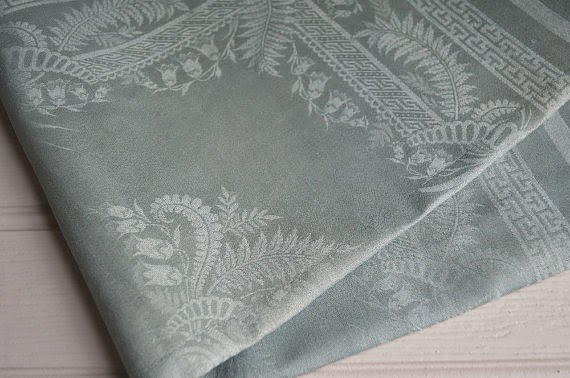
Linen damask designs from Victorian and Edwardian times often feature wonderful fronds of ferns, woven in sinuous borders or decorating medallions in centre of banqueting cloths. Here are just a couple of examples of fern napkins and cloths which have made their way into the Revived Damask collection here at McBurney and Black.


I was intrigued as to how this plant In particular seemed to appear so often on some of the finest pieces. So I began to do some research.......

As you would expect fashion trends and crazes are nothing new. But it would appear that back in the mid 1800s a craze took hold of Victorian England which was to last for over 50 years and which had huge influence in the world not only of botany, but also the decorative arts. The fern motif was presented in many different ways on pottery, glass, wood, printed paper and of course, textiles.

Some of the designs are just breathtaking in the detail; look at the centre of the napkin at the bottom of this group of photos - simply stunning and so accurately reproduced.


Pteridomania was a word coined in 1855 by The writer Charles Kingsley and at the height of the craze in the 1870s Britain was importing the plants from as far afield as Brazil, the Philippines and Tasmania.

I think I'll stick with Fern Fever, just a little easier to pronounce! But I am so glad I took the time to find out more about this fascination with the plant. 

And I love that fine linens continue to feature these delightful leaves in some of the napkins and placemats available today. Nina Campbell has a gorgeous design in her collection, not only embroidered in green, but also in silver and soft gold - just gorgeous.


Sunday, 15 June 2014

Crochet

One of the things that has always fascinated me about textiles is how new things pop up all the time, techniques I wasn't very familiar with, or textiles that I knew little about. Then starts the exploration and research as I try to find out as much as I can about this new subject!

Crochet seems to be the latest of these  - I never learned how to crochet as a child, but rather I was taught to knit and sew. My cousin, however, could create beautiful doilies and runners at the drop of a  hat. Granny McBurney passed that skill to her daughter, my aunt. Obviously my dad didn't need to be taught such skills!

So, whilst I knew a bit about crochet, I had never really delved into the history in any detail until about a year ago when I found the most wonderful pieces of crochet work, mainly as edging to Irish Linen tray cloths and tablecloths. I became curious to know more about this beautiful and skilful craft.

Of course once I started to know more, I began to come across more and more crochet work as I searched out new linens for the collection. Everywhere I turned I seemed to find hairpin work, relief crochet and filet lace crochet.


All sorts of styles and finishes, some quite simple and others more intricate, but all showing how much the cloth or runner was enhanced by the addition of a border or insert.


Whitework embroidery on a tray cloth was not sufficient; this lovely cloth called for a detailed relief work edging. Sadly the body of this particular piece has a lot of damage, but I am determined to use the edging somehow, perhaps overlaid on a contrasting coloured cushion.


The circular cloth above is quite stunning but in today's homes we don't tend to have small tea tables, so I think this would make a wonderful centrepiece on a dining table, layered over a vibrantly coloured tablecloth. It really allows the beautiful crochet border to shine.

Of course crochet was used in many different ways, and recently I found this gorgeous little reticule or opera purse/bag decorated with Irish Crochet lace embroidery. The frilled flower heads are a traditional element to this style of crochet. It gives a lovely 3 dimensional quality to the piece.
Even the plainest of Irish Crochet was considered intricate by comparison with other types, because each of the elements of a design would be made separately and then crocheted together.It was a technique used often for ladies' gloves which would be made of crocheted loops with Irish crochet flowers sewn on the top, just as has been done in this pretty Victorian bag.


I wonder what it will be next!


Monday, 9 June 2014

Happy customers!

At McBurney and Black we just love it when our customers are happy. The time spent refreshing and reviving vintage linens is all worth while when we see them in situ on a dining table!

I have to say that we have some great customers who kindly send us their pictures and here are just a couple.

Revived Damask dinner napkins in Pumpkin. We just love the brown and orange mix to this pretty table setting and the roses are the perfect match!


Another set of Revived Damask napkins winged their way to a home in the South of France and the Cerise Pink looks just gorgeous in this setting. Classic silver napkin rings and lovely boutis quilted French table mats really allow the pink to shine! 


So keep them coming! We love to see our linens in their new homes.


Sunday, 1 June 2014

New Website

At last we have got organised and yesterday the new website was completed and is now live.

www.mcburneyandblack.com

Here we are able to give more information about the services and products we offer, keep buyers updated on new products and colours and generally be more than just a shop.

For purchases the site links directly to the Etsy shop for checkout, so that is still simple and straightforward.

Hope everyone will like it!