Monday, 23 February 2015

A Magnet for Lace!

Having always planned McBurney and Black to be a resource for linen, Irish Linen in particular, my intentions are being hijacked by the wonderful laces, ribbons and trims that keep coming my way. I said to a friend last week that I felt I had become a magnet for lace!

I find it hard to resist the frequent shoebox of lace that beckons and I find that my customers too are enjoying the variety in the shop. What is also fun is to find images of how the lace might have been worn at the time. I recently spied some wonderful postcards, old studio portraits from the early 1900s – here we can see the importance of lace!

In their Sunday best, the men and women were placed in formal poses and then their images captured by the photographer. Whilst I am always intrigued to see the costumes and attire of the time, it is sad that so many years later these images have just been discarded. But they tell us so much about the dress of the period.

One portrait is of a lady standing by a balustrade with a backdrop of a woodland behind her. With her hat perched at a jaunty angle and gloves held tightly is one  hand, she gazes into the distance looking rather miserable, it has to be said.


On the reverse of the photo in wonderful flowing letters is the greeting: Love and all good wishes to Nellie and George from Gussie. I assume that the lady is Gussie herself and she was obviously happy enough to use the portrait as a greeting card, so perhaps her look is a serious or pensive expression rather than a sad one! Just look at the wonderful crocheted lace collar sitting at the neck of the coat.

The second image has been taken by H.J Cowley of The Country Studio, Stroud. A market town in Gloucestershire, this photographic studio would have been the place to go for the country folk of the area wanting a formal portrait to mark a special occasion. An engagement perhaps, or a family gathering.


This image is of a couple in their 20s look unsmiling at the camera, again in rather formal pose. It seems that the idea of smiling for the photographer is one that came later. A huge corsage of flowers adorns the girl’s high necked blouse and if we zoom in , the detail and embellishment of the piece is quite superb. A plain dark skirt, but a very detailed lace trimmed blouse with pintucking and smocking to the front. Her beau has a smartly starched white shirt and they look a handsome pair.


So it looks as if I am destined to offer these beautifully handworked embellishments as well as my Irish Linen specialties! 


Friday, 16 January 2015

The art of napkin folding.

First of all a very belated Happy New Year to everyone!

Somehow December just flew past and January appears to be following suit as sales on the website grow. Most days now entail a trip to the post office with packages of linens and things destined for far flung places and some nearer to home. 

I did manage a day off in late December to accompany New Zealand friends on a visit to Hampton Court Palace. It is years since I had been and I had forgotten quite how fascinating a place it is. In addition to Henry VIII's quarters there are also the Georgian apartments to explore.

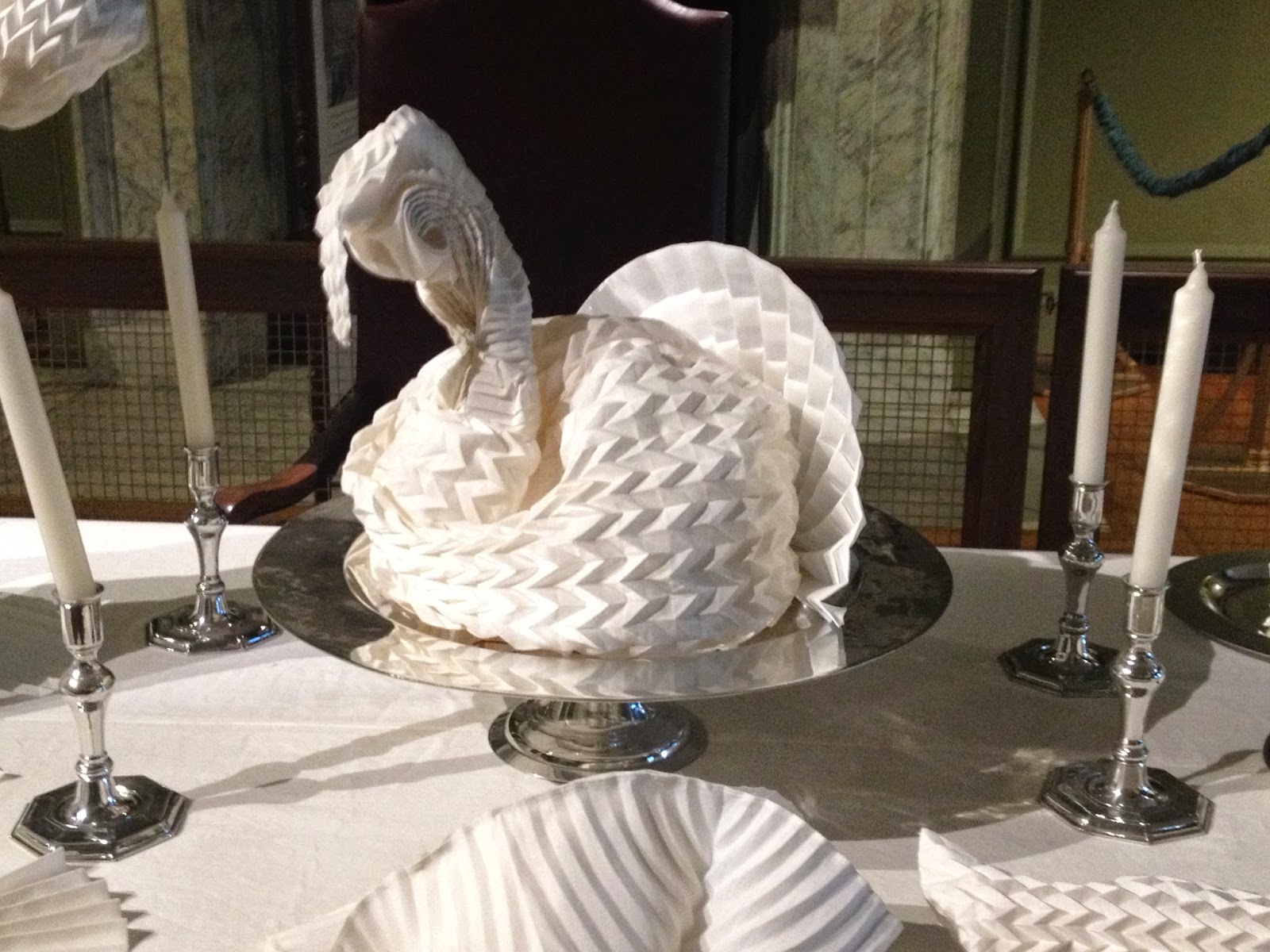
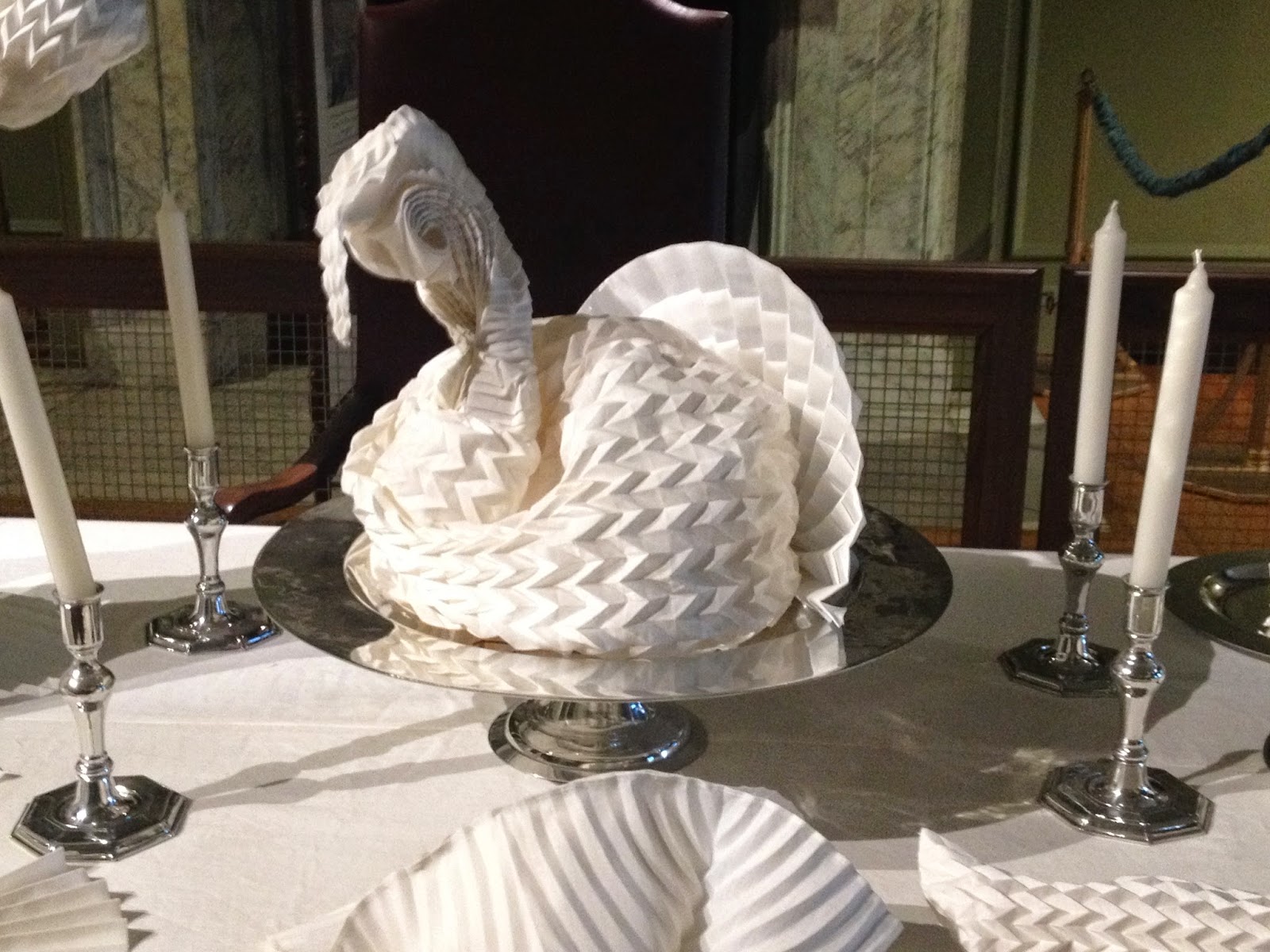
Of course, wherever I go, linen seems to follow me around and as I entered George I's dining room I was amazed to see the most intriguing display of folded napkins.


Yes, that really is a turkey made from linen napkins! Apparently such displays were quite "the thing" in the mid 1600s and1700s with the German town of Nuremburg even boasting a school entirely devoted to teaching the art. So when the Hanoverians arrived in England they brought with them this new way of impressing their dinner guests!

The intricacy of the pieces on display in Hampton Court was most impressive! Quite origami-like, the various pieces on display represented various vegetables and game in an incredibly lifelike fashion. 

Artichokes, a plate of asparagus spears, a cob of corn and even a hare in pride of place to the centre of the table.


We should remember that at that time the grand banquet was a lavish affair, not only intended to feed the diners, but also to ensure that they were fully aware of their host's wealth and status. By creating these amazing displays, the guests would have been left in no doubt as to the grandeur of the occasion. 

So I am feeling the pressure to make my napkins look a bit more special on the dining table, but then wonderful Irish Linen damask designs are so impressive in their own right.......I don't think they really call for any extra pizzazz!


Friday, 21 November 2014

Buttons and bows - and lots more besides!

One of the things I have discovered in the past year or so is that a collection of linens is never just tablecloths, napkins, doilies etc. Very often tucked away in the bottom of a suitcase or box of linens lie all manner of other treasures.

Lengths of lace, collars and cuffs and as the title of this post implies, buttons and bows!


Gorgeous chunky mother of pearl shell buttons, which look just as good from the back as from the front! These ones will look amazing to the centre of a linen cushion I think.

Then there are really unusual buttons made from soutache silk cord. Some are woven into knot-like shapes with rosettes to the centre, some can be quite intricate and fussy, but then there are gems like these - bottle green silk cord wound into a dome, almost looking like little beehives. Simple yet stunning. These are from the 1930s and have survived so very well.


And not forgetting the bling and sparkle pieces! I acquired a box of lace and trims from the estate of a Scottish lady whose sister had been companion to a French widow in Quebec during the 1920s and 30s. When she left to return to Scotland her employer gave her lots of interesting things to bring home with her. In amongst the lace were several envelopes containing the most stunning little diamante pieces. 


Tiny gold tone metal bows studded with diamante, just waiting to adorn an evening jacket.


And the tiniest little flower head buttons you ever did see, each one made up of 16 diamante studs all ready to embellish an evening gown.

It seems that just about every house had its box of lace pieces, but also a button box. Or as I discovered recently about 15 button boxes! The mother of a good friend of mine was a model for some of the leading fashion houses in London during the 1930s and 40s, a really glamorous girl in her day. She passed away last  year and I have had the privilege of helping her daughters sift through the suitcases and boxes of treasures she had kept from those days. Buttons, buckles, more buttons and even more buttons........


Groups of vintage black glass buttons with copper highlights.


 Diamante buckles just waiting to be used.


Soutache frogging from Harrods, still with its original little label!


Black glass buttons that look as though they have gold detailing, but it is just the very reflective finish that gives them this allure.

So McBurney and Black was always intended to be a source for vintage Irish linens, but it is changing by the day! Still the focus is on linen, but it is hard to resist these amazing haberdashery items when they appear!


Tuesday, 11 November 2014

Estate Sale Finds

I was back home in Northern Ireland last week and one of my tasks during my visit was to collect 3 large boxes of linens which had been part of an estate sale in Ballymoney, Co Antrim.

Wealthy farming country surrounds this part of the province and I was thrilled to find the boxes contained some really lovely quality Irish Linens from days past.

Teacloths, tea cosy covers, napkins and tray cloths galore. So it has been a busy laundry time and such a joy to see the rather limp and tired looking pieces come back to life.


These 2 tea cosy covers were looking a bit tired and the pink one had a few light tea stains, but now both are fresh and bright again, ready for a tea party!


Dainty afternoon tea napkins with appliqué motifs and a real County Antrim classic, an embroidered tea cloth from the Old Bleach Linen company of Randalstown, with its distinctive twin needle embroidery work.


There were quite a number of mats and runners all embellished with beautiful whitework embroidery. The houses in this part of the world were certainly graced with some wonderful examples of fine Irish Linen at its best.


A gorgeous oval dressing table mat with magnificent embroidery work. The petals and leaves are filled with the tiniest of seed stitches - it would have taken many hours to complete this intricate work.


A rare and unusual runner with 2 matching coasters, this was probably a runner for a dressing table or chest of drawers. Exceptionally fine linen which had obviously been well cared for as there wasn't a mark or blemish in sight.


And another oval shaped mat with such intricate stitching; these are really special heirloom pieces and I am delighted to have been able to rescue them and add them to the website.

It is time for them to find a new home and I am just so fortunate to have the opportunity to appreciate the workmanship and quality for the short time that they are in the shop.


Thursday, 2 October 2014

Recycling and repurposing - new ideas?! Hardly.......

I find it very amusing that we think today that recycling is a great new concept, repurposing is another buzz word that we often hear.

Sorry to disappoint anyone, but our grandmothers and great grandmothers had the concept down to a fine art, long before the idea was resurrected in the 1990s and I am reminded of it each time I find a new batch of vintage linens and accessories.


This group of doilies is a perfect example. You can see that the linen centre to each doilie is actually a piece rescued from a damask cloth or napkin that has most likely been damaged. Rather than discard the linen, the frugally minded lady of the house has cut out the undamaged pieces and crocheted or knitted a deep edging so that these precious pieces could still serve a useful purpose and look delightful at the same time!

Going through boxes and cases from an estate sale recently I came on the usual box of pieces of lace. I think just about every house had one of these boxes, usually it had contained silk stockings but was used to hoard the precious pieces of lace which were being saved to rework into different garments and hankies. Often the pieces I find are actually a loop of lace, most likely rescued from a petticoat, saved so that it could be used for something else. Here is one such piece, a pretty loop of ivory filet lace with a  scalloped edge.


 Searching further through the same box of treasures I found a bodice in the most gorgeous peach coloured crepe de chine and along the top was an edging of exactly this design of lace! All hand sewn with narrow ribbon threaded through it to gather it to shape. Even the waistline was finished with a running stitch of the finest elastic thread. This must have made a lovely set of lingerie, shame that the petticoat didn't survive.


So this particular loop of lace was never recycled by its original owner, but I hope that now it will find a new home and become part of another project.

P.S.

At the very bottom of the box was a small blue card, "ERL" Brand Lace is the title. ERL standing for Equals Real Lace! The advertising slogan at the bottom tells us that "ERL equals real lace but Costs Far Less"! The card also tells the buyer that "If you are well satisfied with "ERL" Brand Lace, kindly recommend it to you friends. In doing so you will be helping to support an ALL-BRITISH INDUSTRY." 

There is even a returns policy on the reverse worded in a most charming fashion:

"Any lady, having JUST CAUSE to complain, who sends the whole 6 yard length with this card to the manufacturers A. Herbert Woolley & Co., Nottingham, will receive a perfect length in return, without charge, and post free"

Weren't these guys well ahead of their time with their marketing strategies and customer satisfaction goals!


Friday, 5 September 2014

Gorgeous european linens from the 1930s


Whilst my main collecting interest has always been Irish Linen, I sometimes just cannot resist indulging in linens from elsewhere.

A month or so ago I was fortunate enough to acquire 2 huge bags full of bedlinen, which had been the trousseau of a Czechoslovakian lady. Just prior to the outbreak of  war in 1939 she was studying in Switzerland and her parents, who were Jewish and could see what the future held, told her not to come home but to go to friends in England and they arranged to send on her belongings. Included in the parcels were these beautiful embroidered and monogrammed linens.


It is a real privilege to handle and examine these treasured pieces, which found their way to join their owner as she began her new life. Tragically she was never to see her parents again. She married in London and spent the rest of her days here, but had no family to whom she could pass on these heirlooms.

The quality of the linen is exceptional. It is fine and very very smooth. As for the embroidery – it too is the finest quality and has been meticulously hand sewn to each piece. Extravagant scrolls and dainty flower heads are intertwined to shape the monograms and some have the tiniest seed stitches. Appenzell work is featured in some of the decoration together with fine drawn thread work. It would have taken many hours to complete such exquisite designs. The French seams are the narrowest I have ever seen, just 3 millimetres deep! 


Of course the European bedlinen tradition is quite different to ours and the sizes of the pillowcases are unusual – one style measures 80 x 95 cms! There are also what I believe to be blanket covers. At first glance they seemed like a single duvet cover with a fold down flap or return at the top where we find the embroidery and monogram. On closer inspection however, it is clear that there is no top to the cover, just a series of buttonholes all around a deep folded border with mitred corners to one end. A German friend tells me that a blanket would have been inserted and then the linen would be buttoned to it to form the bedcover – most unusual, but how lovely to have it finished with the embroidered return to the top. Apologies for the creases in these images, the blanket covers haven't been through the laundry process yet!


The pillowcases were closed in the old fashioned manner. A strip of linen with buttons attached was placed beneath the opening and both sides were then buttoned onto the strip, which would be removed before laundering. Quite a practical idea I think. Unfortunately few of the strips remain.


One set is finished with an edging of Irish Crochet, all intact and quite lovely. Sadly some of the linen is badly marked and is beyond saving, but the embroidery simply has to be salvaged. I have started soaking and laundering and it is a delight to see some of the storage marks disappear and the linen come up fresh and crisp. It makes a wonderful rustling sound!

As to how I will use the rescued embroideries I am not sure, but I have to find a way to give a new life to this stunning work.